Which Medical Billing and Coding Certification Should You Get? (2026 Comparison)
Key takeaway: Pick the certification by the job you want, not by the exam that sounds easiest. Physician practice and outpatient coding: CPC, CCA, or CBCS. Billing and revenue cycle: CPB or CBCS. Hospital inpatient coding: CCS. Health information roles with a two-year degree: RHIT. Then choose a program that maps to that exam.
You do not need every credential. You need the one that shows up in the postings you would actually apply to. Finishing a program does not certify you. AAPC’s CPC still carries the CPC-A apprentice designation until you document experience. This site is not affiliated with AAPC, AHIMA, NHA, or CAHIIM. Exam formats, eligibility, and fees change; confirm current rules on each body’s site. We do not quote exam fees.
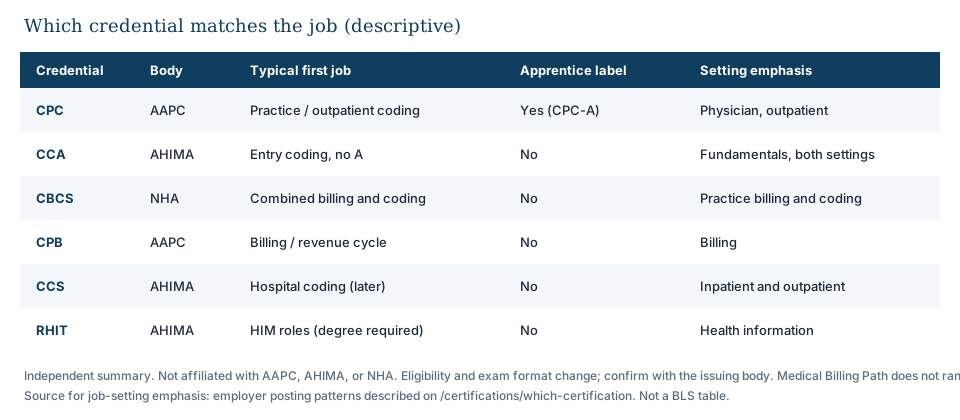
The comparison
| Credential | Body | Typical use | Prerequisite (as published) | Apprentice period | Setting emphasis |
|---|---|---|---|---|---|
| CPC | AAPC | First coding job in a practice or outpatient center | None required; education recommended | Yes (CPC-A) | Physician, outpatient |
| CCA | AHIMA | First coding job, no apprentice label | High school diploma | No | Fundamentals across settings |
| CBCS | NHA | Combined billing and coding at entry level | Diploma plus training or experience | No | Practice billing and coding |
| CPB | AAPC | Billing and revenue cycle roles | None required | No | Billing |
| CCS | AHIMA | Hospital inpatient coding | Pathways combining credentials, coursework, or experience | No | Inpatient and outpatient |
| RHIT | AHIMA | Health information roles | CAHIIM-accredited degree | No | Health information management |
Confirm eligibility and exam format with the certifying body before you register. Summaries on this site are descriptive, not official policy.
Work this in ten minutes
- Do you want to code, bill, or manage health information? Billing: CPB or CBCS. Health information: RHIT, which means a CAHIIM-accredited degree. Coding: continue.
- Physician practice or hospital? Practice or outpatient: CPC or CCA. Hospital inpatient: CCS, usually after the CCA or a degree, not as a first exam.
- Does the apprentice period bother you? If yes, the CCA avoids it. If you are fine starting as CPC-A, the CPC is the credential most often named in practice postings.
- Which exam is your intended program built around? Match the program to the answer above. If admissions cannot name an exam, pick a different program.
Read the postings, not the brochure
Before you commit, search “medical coder” and “medical biller” plus your city. Open ten listings. Tally which credentials appear in the requirements. Employers, not certifying bodies, decide which letters matter where you live.
A military spouse who will move in two years should weight nationally recognized credentials (CPC, CCA, CCS, RHIT) over a school-only certificate. A parent who needs the shortest path into a local clinic can let those ten postings pick the exam, then find a program that maps to it.
Open-book exams, renewal, and second credentials
- The exam is open-book for the manuals, and it is still hard. Speed with the books is a skill. Programs that skip timed practice leave you short.
- Membership and renewal are separate from passing. AAPC, AHIMA, and NHA each have their own cycle, usually two years, with continuing education units. Budget time for that after you are hired.
- Holding two credentials is common later, not on day one. A CPC plus a CCS is a career move after you have inpatient exposure. Do not pay for a second exam until a job or a posting asks for it.
- A school “exam voucher” is not a pass. It is a prepaid attempt. Ask whether unused vouchers expire and what happens after a fail.
Which certification pays the most?
BLS does not publish pay by credential. There is no official “CPC salary” or “CCS salary” table. The occupation that includes billers and coders had a median of $51,140 in May 2025, with a 10th percentile of $37,000 and a 90th of $81,150. Across the industry, hospital inpatient and specialty coding (often CCS-level work) are described as sitting higher in that range than entry billing, but that is observation, not a BLS split. Pick the credential the job you want names.
What each exam is for
CPC (AAPC). Deep on CPT, the procedure codes used in physician offices. Open manuals. The one you will see named most often in outpatient job ads. Details: CPC guide.
CCA (AHIMA). Fundamentals across hospital and physician settings, including a first look at ICD-10-PCS. No apprentice label. A common first AHIMA credential on the way to the CCS. Details: CCA guide.
CCS (AHIMA). Hospital coding in earnest: ICD-10-PCS, DRG assignment, and scenario coding. Most people are not ready for this as a first exam. Details: CCS guide.
CBCS (NHA). Combined billing and coding at entry level. Common in career-school programs and accepted in many practices. For coding-only hospital roles, compare it with CPC or CCA first. Details: CBCS guide.
CPB (AAPC). Billing depth: payer rules, claims, denials, collections. Pair it with a coding credential later if you do both. Details: CPB guide.
RHIT (AHIMA). Not a coding-only credential. Health information management, including coding, tied to a CAHIIM-accredited degree. Details: RHIT guide.
Questions to ask before you register
- Does the program’s syllabus map to this exam’s published blueprint?
- Do graduates sit for this exam, and will the school say how many did last year?
- Are current-year CPT, ICD-10-CM, and HCPCS manuals included, or do you buy them?
- For the CPC: do you understand you will be CPC-A until experience is documented?
- For the RHIT: is the program CAHIIM accredited, not just the college?
If you want the step-by-step from high school diploma to first job, use how to become a medical coder.
Frequently asked questions
Which medical coding certification do employers ask for?
Can I hold more than one certification?
Should I get certified before or after I find a job?
Is certification required by law?
Does the CCA have an apprentice period like the CPC?
Can I take the RHIT without a degree?
Which certification should a career changer get first?
See something out of date? Tell us and we will check the source and fix it. Material corrections are listed on the corrections log.